When a part fails FAI, which balloon does the evidence belong to?
Five founder-authored synthetic cards follow one made-up inspection workflow from ballooned drawing characteristics to measurement evidence to a FAI / AS9102 package.
These are founder-authored synthetic workflow scenarios. They are not customer data, not product UI, not product proof, and not evidence of demand.No confidential, ITAR, CUI, export-controlled, customer-restricted, or proprietary documents are needed.
SYNTHETIC PART · DWG ST-001 · REV BSTATIC ILLUSTRATION
All five balloons and their evidence status are shown together below.
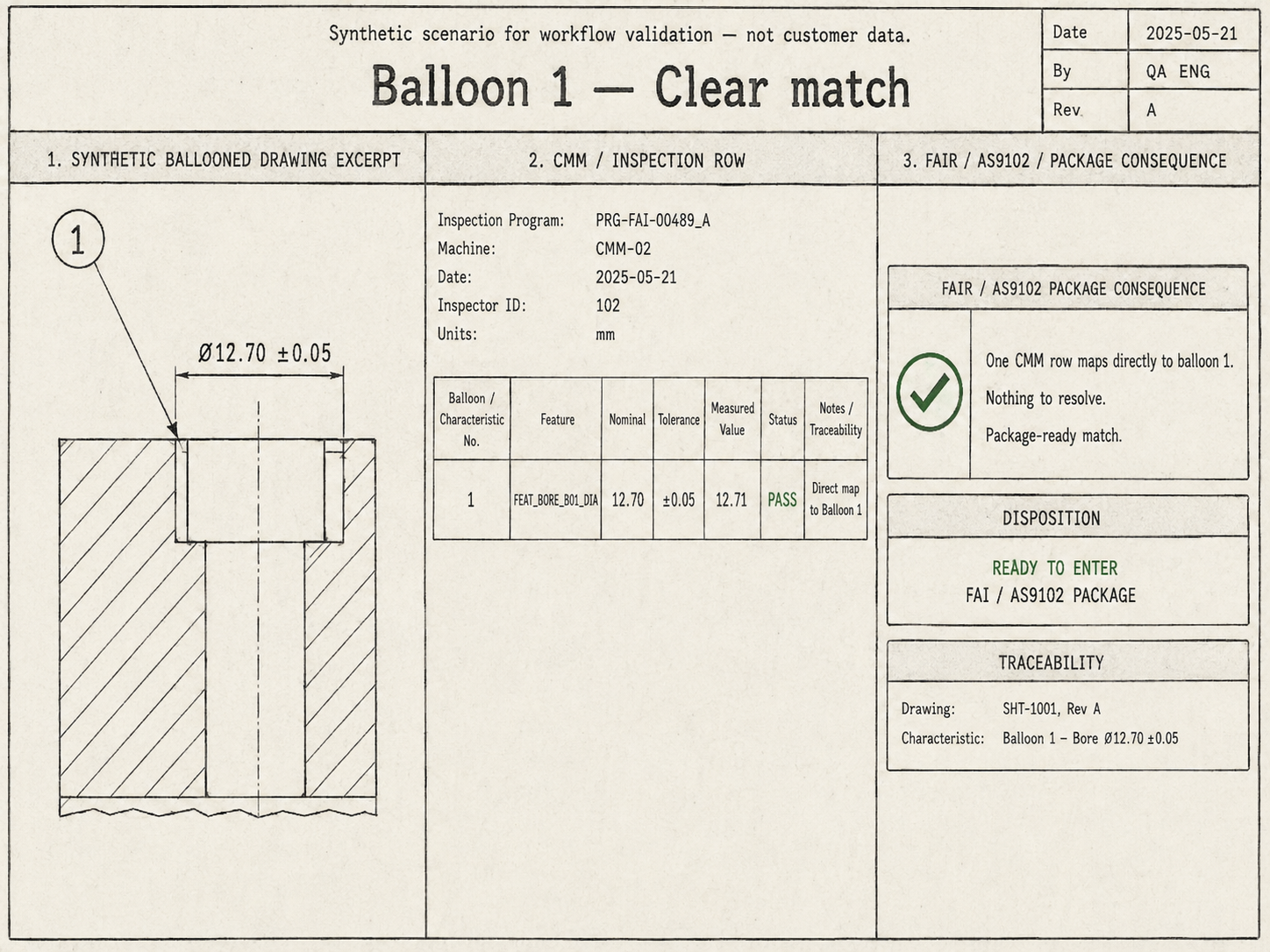
BLN 1FEAT_BORE_B01_DIA = 12.71 · PASSCLEAR MATCH
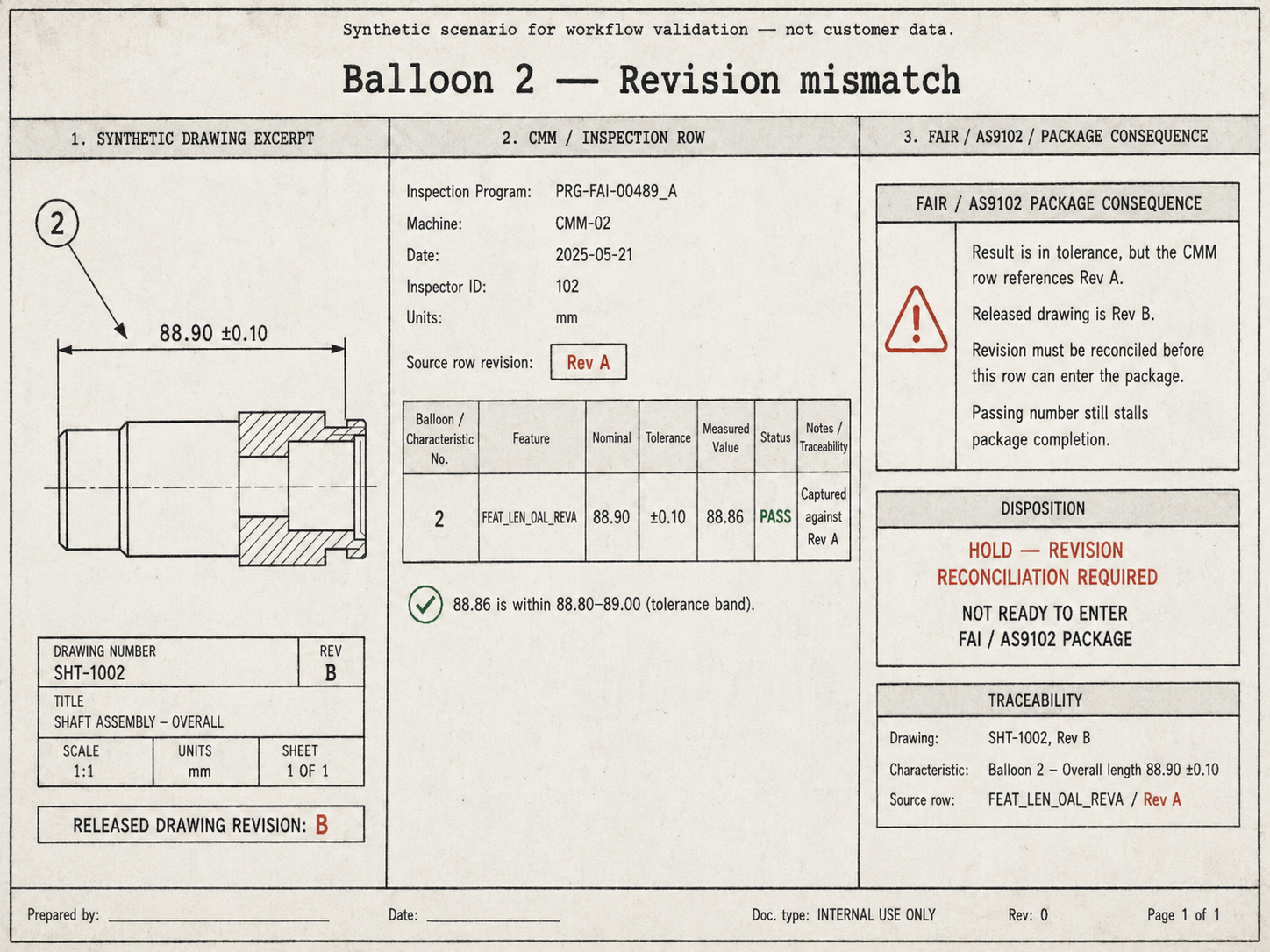
BLN 2FEAT_LEN_OAL_REVA = 88.86 · in tolerance, Rev AREV MISMATCH
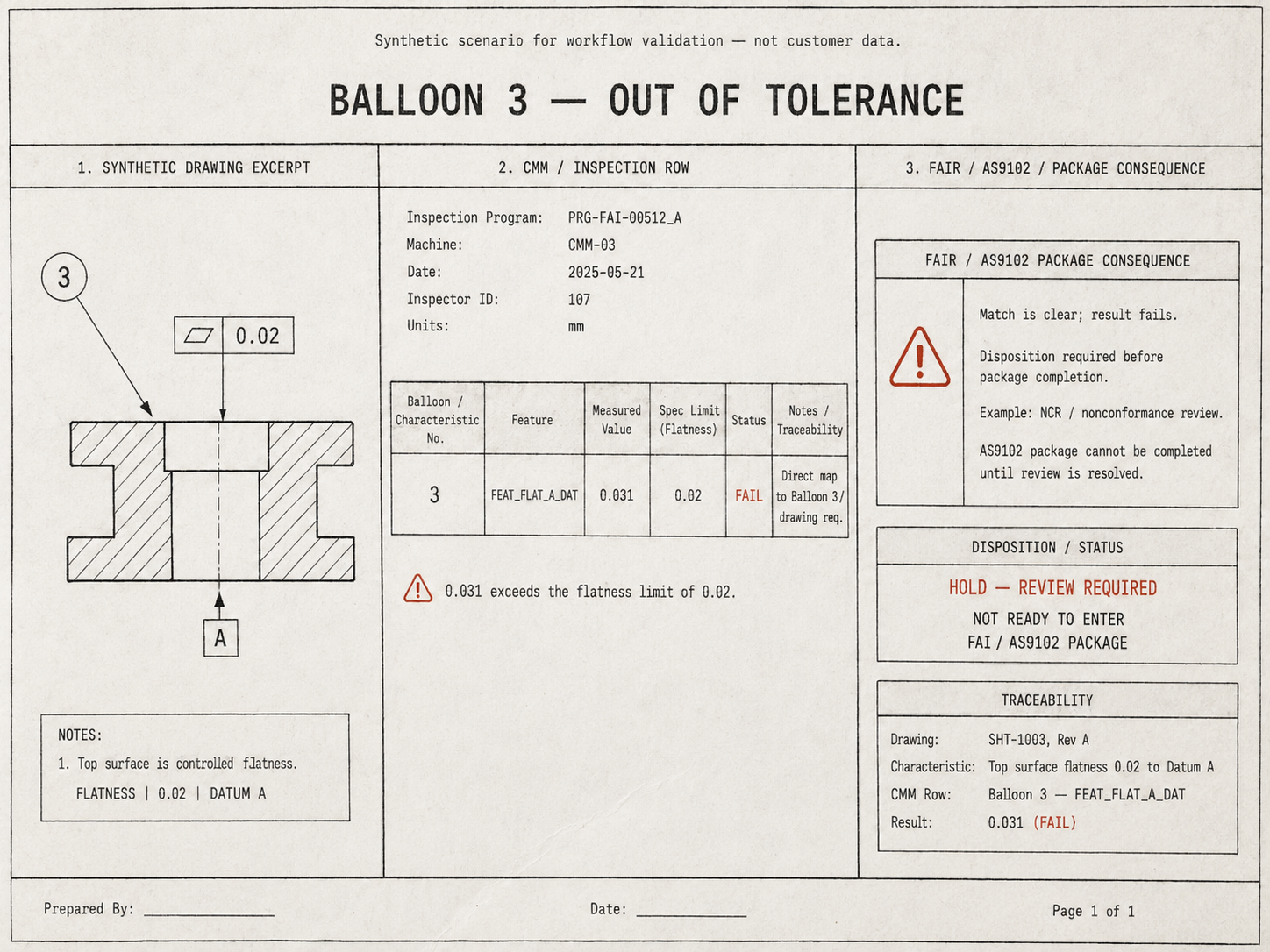
BLN 3FEAT_FLAT_A_DAT = 0.031 vs 0.02 · FAILOUT OF TOL
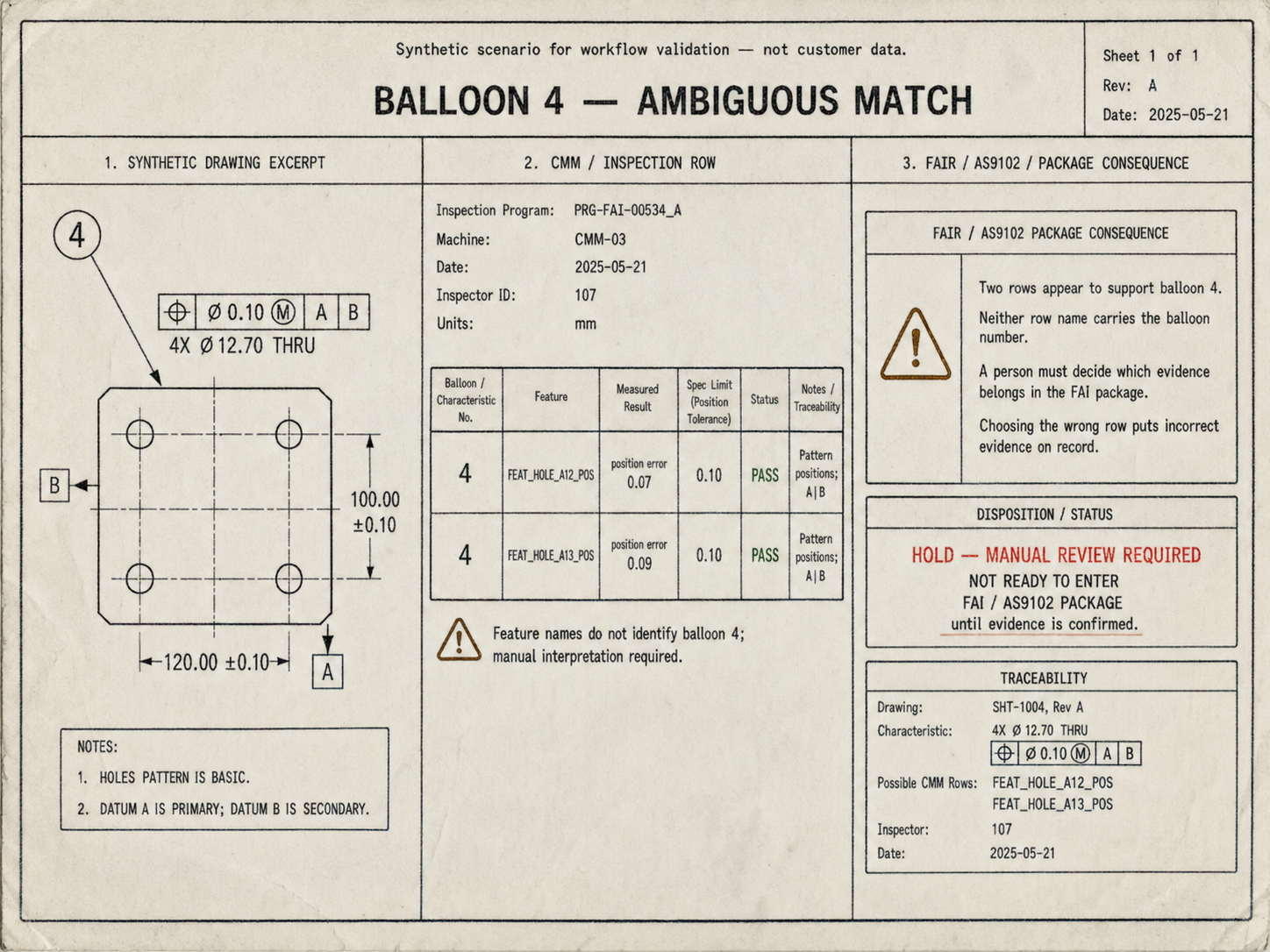
BLN 4HOLE_A12_POS / HOLE_A13_POS · both plausibleAMBIGUOUS
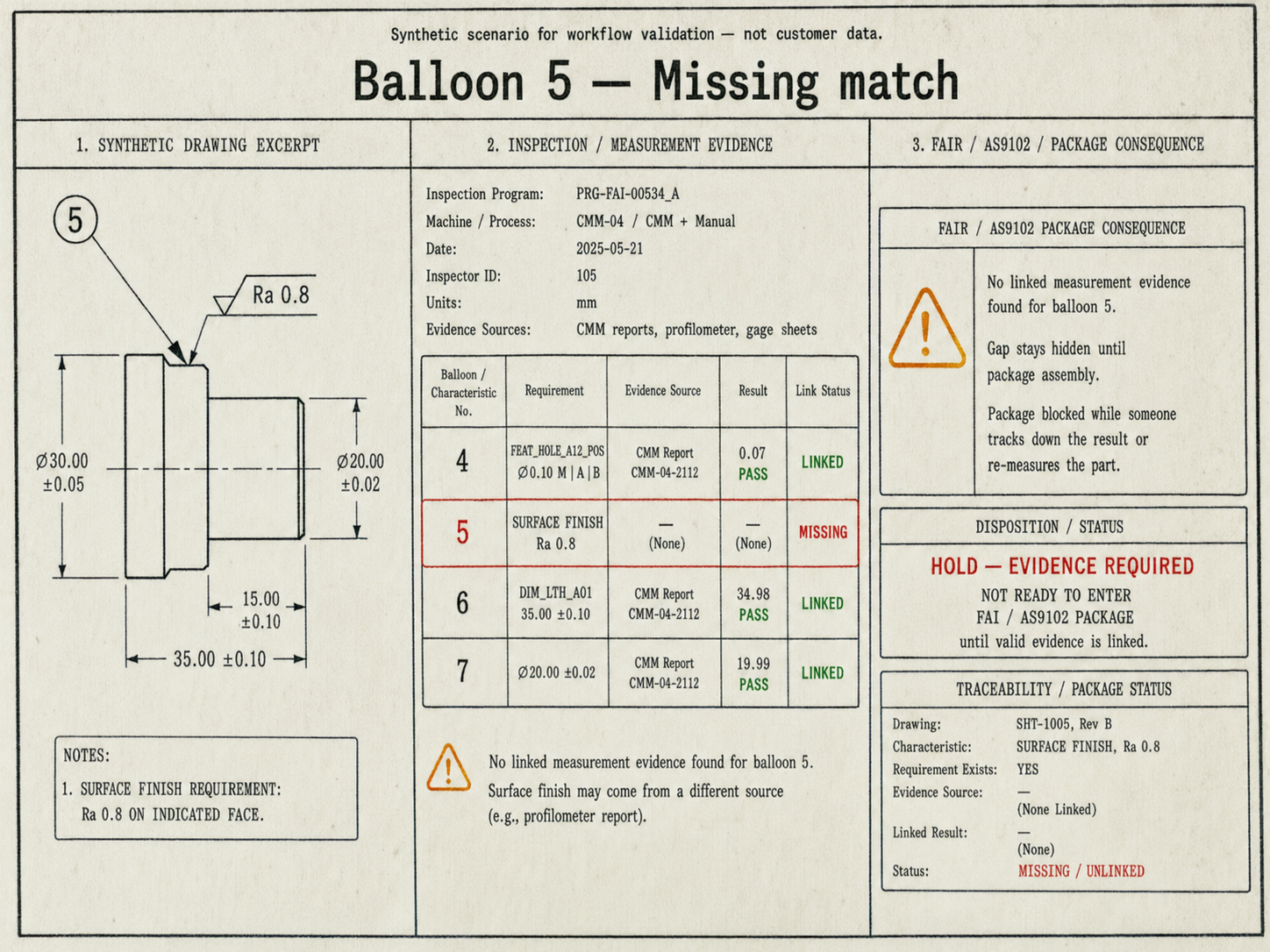
BLN 5Ra 0.8 requirement · no linked evidenceMISSING
AS9102 Form 3FAIRGD&TRevision controlCMM rowNCRRa 0.8Balloon to evidence
What you are looking at
A synthetic scenario, built to be corrected
The part, drawing numbers, tolerances, CMM rows, and statuses are invented. The point is not to demonstrate a tool; it is to make the inspection-documentation question concrete enough for a practitioner to correct.
These are founder-authored synthetic workflow scenarios. They are not customer data, not product UI, not product proof, and not evidence of demand.
The workflow gap
Three documents describe the same feature. They still have to be reconciled.
Each dimension can appear as a requirement on a drawing, a row in a measurement report, and a line in a FAI package. These synthetic cards ask where that link breaks or slows down.
1
The drawing requirement
A ballooned characteristic with a tolerance, datum context, and revision state.
BLN 3 · FLATNESS 0.02 | A
REV B · released drawing
2
The measurement evidence
A CMM report, gauge log, or supplier certificate named by feature, instrument, or program convention.
CMM ROW "FEAT_FLAT_A_DAT" = 0.031
status FAIL · mapped to BLN 3
3
The package consequence
Form 3 needs defensible evidence for each characteristic before the package can move forward.
AS9102 FORM 3 · CHAR 3
HOLD — review required before completion
The five cards
From ballooned characteristic to package consequence
The five cards cover a deliberately broad failure spectrum: clear match, revision mismatch, out of tolerance, ambiguous match, and missing evidence. Select a card to expand it.
One named CMM row clearly maps to balloon 1 and is in tolerance. This is the clean baseline.
DrawingBore diameter 12.70 +/-0.05.
EvidenceFEAT_BORE_B01_DIA = 12.71 PASS.
PackageResult can be entered without reconciliation.
Synthetic illustration — invented part and data, not customer material.
The value passes, but the evidence was captured against Rev A while the released drawing is Rev B.
DrawingOverall length 88.90 +/-0.10, released Rev B.
EvidenceFEAT_LEN_OAL_REVA = 88.86, in tolerance but Rev A.
PackagePassing number still needs revision reconciliation.
Synthetic illustration — invented part and data, not customer material.
The match is clear and the result fails. The package needs a disposition before completion.
DrawingFlatness 0.02 to datum A.
EvidenceFEAT_FLAT_A_DAT = 0.031 FAIL.
PackageReview or NCR-style disposition required.
Synthetic illustration — invented part and data, not customer material.
Two near-identical rows both look plausible for the same hole-pattern balloon.
DrawingHole-pattern position requirement.
EvidenceHOLE_A12_POS and HOLE_A13_POS both plausible.
PackageA person must choose defensible evidence.
Synthetic illustration — invented part and data, not customer material.
A surface-finish requirement has no linked measurement evidence in the package path.
DrawingSurface finish Ra 0.8.
EvidenceNo linked row; likely different instrument source.
PackageEvidence must be found or re-measured.
Synthetic illustration — invented part and data, not customer material.
Founder-operated demo
The browser walkthrough is not public yet
A short interactive walkthrough of these five synthetic cases exists as a founder-operated demo. Ask by email if you want to see it.
What we are validating
Two directions of the same link. Which one creates more avoidable work?
Both problems live between the balloon and the evidence. The research question is deliberately open so respondents can reject this framing or point to something else.
A · FAI prep
Preparing the FAI
Ballooning the drawing and extracting characteristics into Form 3.
Planning which instrument or program covers each balloon.
Catching missing planned evidence before package assembly.
PLAN COVERAGE · SYNTHETIC
BLN 1-4 CMM PROGRAM planned
BLN 5 SURFACE FINISH Ra 0.8 no instrument assigned
B · Matching back
Matching results back to balloons
Mapping CMM rows, gauge logs, and certificates back to balloon numbers.
Flagging evidence captured against a superseded revision.
Resolving ambiguity when multiple rows fit the same balloon.
EVIDENCE MAP · SYNTHETIC
FEAT_BORE_B01_DIA → BLN 1 clear match
FEAT_LEN_OAL_REVA → BLN 2 Rev A capture
FEAT_HOLE_A12/13 → BLN 4 ambiguous
Ra 0.8 → BLN 5 no candidate
Who we want to hear from
People who sign the forms, run the measurements, or fix the package.
Quality managers
You own the FAIR package and know where review time concentrates.
Metrology / CMM
You know how feature names, programs, and result tables get interpreted later.
Manufacturing engineers
You see the impact when revision or evidence gaps surface late.
Supplier quality
You reconcile supplied evidence against drawing and customer package expectations.
The one question
Does this match how the work actually goes?
A one-line email answer is useful, especially if the honest answer is that these cards emphasize the wrong thing. There is nothing to buy and nothing to sign up for; this is a research conversation.